
Written from the field by Senior Project Engineer Oliver Port
Why leak location in water pipelines isn’t always straightforward
In water and wastewater networks, leak detection is only part of the challenge. Knowing where the leak is located can be just as difficult, especially on long pipelines with limited access and variable operating conditions.
In most cases, the negative pressure wave (NPW) method is the preferred method for leak location. It’s fast and accurate when the required conditions are met, but like any method, it depends on certain conditions, particularly the accurate GPS timestamping of data from each of the sensors.
When this is not possible, NPW leak location performance can be affected.
That’s exactly what we saw on a recent water pipeline event.
What happens when standard leak location doesn’t work?
During a recent event, the NPW method could not be used as the locations for the sensors meant it was impossible to install GPS antennas with a clear view of the sky. This is a requirement of the accurate timings needed for NPW location.
Instead of relying on a single method, we developed an alternative approach using the available pressure data: the pressure difference method.
Using pressure difference to locate leaks in water pipelines
Instead of relying on GPS timestamped pressure data, we applied a simpler principle: how pressure changes along the pipeline.
The method compares pressure behaviour at the inlet (pumping station) with readings from downstream units. If the pipeline is losing more pressure than expected between those points, it indicates a leak somewhere in-between (see Figure 1).
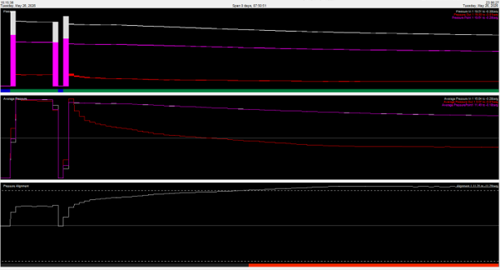
Figure 1: Pressure alignment between upstream (white line) and downstream units (pink and red lines). On the left, consistent pressures during leak free conditions can be seen and deviation during the leak event can be seen on the right (bottom graph with red alarm status bar). Increasing differences in pressure indicate product loss along the pipeline.
By looking at the relative size of the pressure drops, we can estimate where along the pipeline the leak is located without relying on GPS timestamped data.
This approach becomes more accurate as more monitoring points are added, but it can still provide useful insight with only two units installed.
What the data revealed about the location
The pressure drops from the leak event are picked up from Atmos' hardware. As the units don’t have precise GPS timestamping available, they do not line up and the drops at each border of the pipeline appear further than transit time apart and so NPW location cannot be used. However, when we reprocessed the event using the pressure difference method, the result is very different.
Once the leak event is detected by the NPW, the new pressure difference method can be used to estimate the location, which is roughly halfway along the line (see Figure 2).
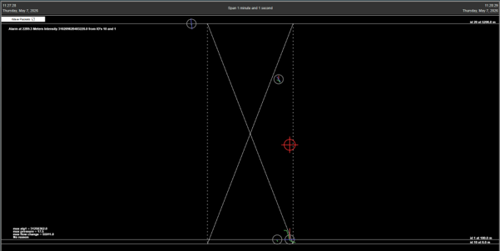
Figure 2: Pressure difference method applied to the same event. The estimated leak location is shown relative to the pipeline layout.
Why this matters for water leak detection
In real-world water networks, data is rarely perfect. Signal noise, operational variability and real-world limitations all affect how clearly and accurately events can be captured.
What this example shows is that:
- No single method should be relied on in isolation
- Alternative approaches can provide valuable cross-checks
- Practical leak location is about using the data available, not waiting for ideal conditions
The pressure difference method doesn’t replace NPW, it complements it.
In some installations, it is not possible to deploy the GPS infrastructure required for timing-based methods. In these cases, approaches such as the pressure difference method provide a practical way to support leak location.
When it is possible to install GPS antennas, NPW remains the preferred method for fast and accurate leak location. However, using pressure difference analysis provides a method that can help to support the NPW result.
The pressure difference method also opens up opportunities to monitor pipelines where precise locations may not be necessary, for example manufacturing plants or refineries, where pipelines are mainly on site and above ground.
At these locations, using a greater number of monitoring points to improve sensitivity becomes more important than accurately locating larger leaks.
A more flexible approach to leak location in water networks
From a field perspective, this is about adaptability.
Pipelines don’t behave perfectly, and neither does data. Having multiple ways to interpret what’s happening in the system means we can still deliver useful answers, even when conditions aren’t ideal.
For operators, that translates into:
- Higher confidence in leak location
- Faster decision-making
- Reduced time spent investigating the wrong section of pipeline
Looking ahead
Across my blog series, we’ve looked at how Atmos Sentinel performs in real-world conditions, from pressure spikes to small leaks and intermittent failures.
This example shows how we continue to adapt and improve our leak location methods for complex field conditions.
Because in water leak detection, it’s not just about having the right tools, it’s about knowing how to apply them when the situation isn’t straightforward.