Key pipeline solution updates
Building on the momentum from the end of 2025, the first quarter of 2026 has seen Atmos continue to support customers across aviation, hydrogen, oil and gas and water networks worldwide.
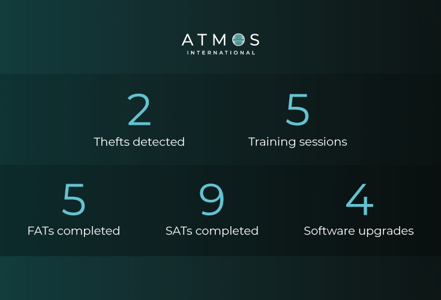
This quarter highlights our ability to deliver reliable leak detection, adapt to new energy applications and support customers in complex operating environments.
Below is a selection of key stories from across the business, including:
- Aviation: expanding hydrant monitoring across global airports
- Hydrogen and energy transition: supporting new pipeline applications
- Theft detection: continued success in Asia
- Water: advancing leak detection on rising sewer mains
Aviation: expanding hydrant monitoring across global airports
Atmos continued to strengthen its position in aviation leak detection, with multiple successful deployments, trials and commissioning activities across major international airports.
Europe
Atmos supported commissioning and testing activities across major European aviation hubs, including large scale hydrant networks with complex operational requirements.
Work included installation and integration of the Atmos Tightness Monitor across multi-section systems, with full SCADA integration to enable automated testing processes.
A key part of the work involved training operators to use the Atmos Leak Trial Manifold, enabling controlled leak simulation for system testing and ongoing integrity verification. Field setup and testing activities were carried out using a combination of monitoring and simulation equipment (see Figure 1), supporting both commissioning and operator training.
In addition, successful trials using portable systems confirmed hydrant integrity and strengthened internal capability through hands on training.
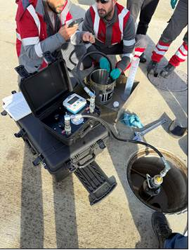
Figure 1: On site setup and testing equipment used during commissioning and training at an airport in Europe
Oceania
Atmos successfully commissioned a fixed hydrant leak detection system for a major airport in Oceania.
The system, covering multiple sections, completed site acceptance testing with full approval following a period of intensive site work. The deployment demonstrates continued growth in long term aviation partnerships in the region.
Further expansion is already planned, with additional sections scheduled for implementation
USA
Atmos completed the first large scale trial of Atmos Pit Sentry in the United States, with 100 units delivered in collaboration with industry partners.
The units were prepared and configured ahead of deployment (see Figure 2), before being packaged and shipped to support the trial.
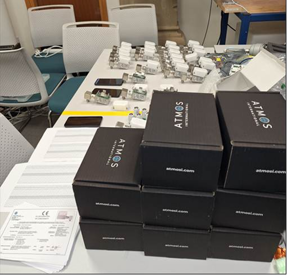
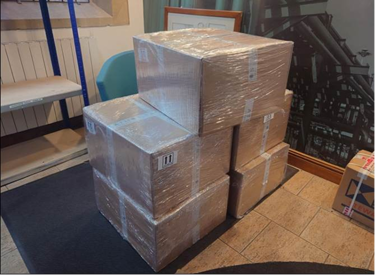
Figure 2: Atmos Pit Sentry units prepared and configured ahead of large scale deployment
The system digitizes pit valve integrity testing, reducing manual inspection requirements while improving safety and efficiency.
Initial feedback from the operator has been positive, with plans to expand deployment across the wider airport network as construction progresses.
Discover how Atmos' effective monitoring of aviation fuel hydrants supports airports to have a safe, reliable and consistent fuel supply
Tightness monitoring solutions
Hydrogen and energy transition: supporting new pipeline applications
Atmos continues to support the transition to new energy sources, with successful deployments on hydrogen and mixed gas pipelines.
Atmos Wave Flow systems recently passed final testing on hydrogen and methane pipelines, demonstrating strong performance in both sensitivity and reliability.
In Asia, a hydrogen pipeline successfully completed site acceptance testing, with two real leaks introduced and detected within expected timeframes by Atmos Pipe. The system demonstrated high sensitivity, identifying leak behavior at less than one percent of flow rate (see Figure 3), reinforcing its suitability for hydrogen applications.
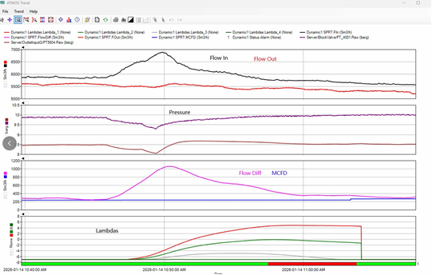
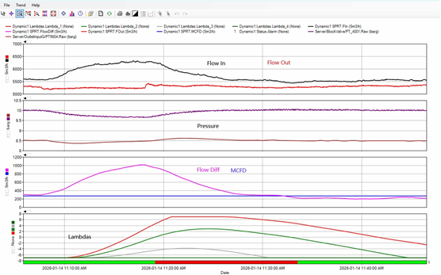
Figure 3: Detection trends showing system response to simulated hydrogen leak conditions
Learn more about how Atmos supports complex, evolving hydrogen networks
Theft detection: continued success in Asia
Atmos systems continue to play a critical role in detecting illegal activity and protecting pipeline infrastructure.
A theft event was detected during early morning operations, with Atmos Wave identifying a real leak and providing an accurate location estimate. Analysis of system data confirmed a series of alarms, with the initial event accurately identified as a theft (see Figure 4).
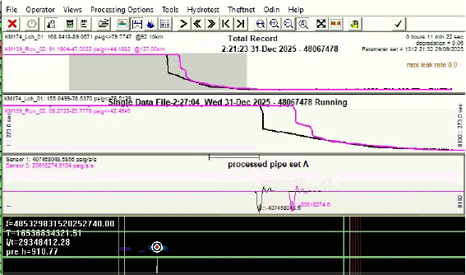
Figure 4: Detection data highlighting the identified theft event
The rapid detection enabled the operator to respond quickly and locate the illegal connection within a couple of hours.
A second theft event was later detected on the same pipeline, with the system again accurately identifying the location. On site inspection confirmed illegal tapping equipment, including storage ponds and transfer hoses.
Excavation of the site revealed the tapping point, along with the physical connection to the pipeline and supporting infrastructure used to conceal the operation (see Figure 5).
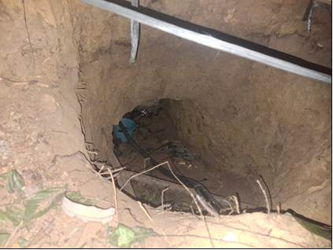
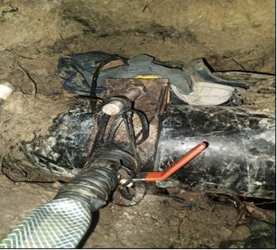
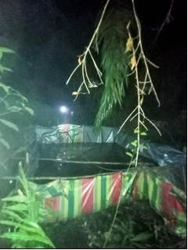
Figure 5: Excavation revealing a tunnel leading to the illegal tapping location (left), a close up of the illegal tapping connection (middle) and surface structure used to support and conceal the theft operation (right)
These events highlight the importance of reliable, well-tuned leak detection systems in high risk environments.
Fuel theft has always been a global issue, but the underlying causes can vary from region to region.
Find out more about how we overcome fuel theft globally
Read our global theft ebook Theft detection solutions
Water: advancing leak detection on rising sewer mains
Atmos achieved a significant milestone in wastewater monitoring with successful leak trials on a rising sewer main in the UK.
For the first time, negative pressure wave leak detection and location were tested and proven on this type of pipeline.
Ten leaks were generated by extracting wastewater at a midpoint using a controlled setup, allowing performance to be tested under realistic conditions.
The controlled leaks were detected and located with high accuracy. Detection results show each identified event and its estimated location (see Figure 6), demonstrating strong correlation with the true leak positions.
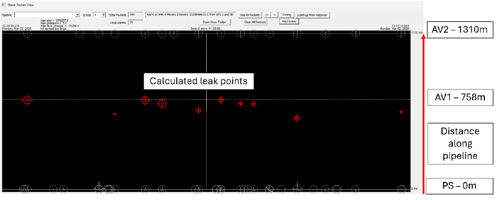
Figure 6: Detection results showing controlled leak events and their estimated locations (actual leak location shown in dotted white line: AV1 - 780m)
All estimated locations were within 150 meters of the true position, with several within 10 meters. These results demonstrate strong potential for wider deployment across wastewater networks.
Discover how we make it possible to detect newly forming and existing leaks for both clean water and wastewater pipelines
Continuing to deliver globally, whatever the conditions
From aviation hubs and hydrogen pipelines to wastewater networks and remote infrastructure, Atmos continues to support customers across a wide range of industries and environments.
This quarter’s work has taken place across busy international airports, remote field locations, and regions facing operational and external challenges. Whether working in harsh weather, complex terrain or uncertain conditions, our teams remain focused on delivering reliable leak detection and monitoring where it matters most.
Our customers operate critical infrastructure and consistent performance is essential. That’s why our approach remains the same: to provide dependable systems, respond when it counts and support safe pipeline operations without interruption.