
Invisible infrastructure in hydrogen-ready gas networks
An editorial by Atmos International has been published in World Pipelines, exploring how pipeline data and simulation are becoming critical to the operation of hydrogen-ready gas networks.
Written by Garry Hanmer, Principal Simulation Consultant, the article examines how gas distribution systems are evolving as hydrogen and biomethane are introduced. Networks that were originally designed for stable, uniform gas are now operating under far more dynamic conditions, where gas composition, pressure behavior and energy content can vary across both time and location.
The feature highlights how traditional monitoring approaches alone are no longer sufficient to provide full system visibility. Instead, it explores how data-driven models and digital systems can extend the value of existing instrumentation, enabling operators to understand conditions across the entire network, including areas without direct measurement.
The article also considers the operational and commercial challenges introduced by blended gas networks, from managing changing physical constraints to ensuring accurate, fair billing as energy content varies. It explains how simulation and modeled data can support predictive decision-making (see Figure 1), helping operators anticipate risks, manage system limits and adapt to evolving conditions.
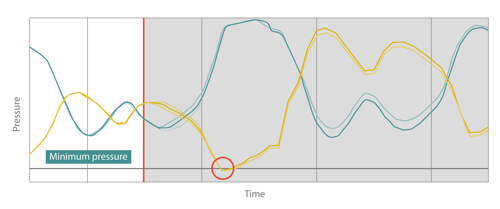
Figure 1: Trending data from a live pipeline’s recent activity (light background), along with the look-ahead’s prediction of a future scenario. The circled area signposts a potential minimum pressure violation that can be prevented by taking actions early
Read the full editorial
Read the full article in the latest issue of World Pipelines to discover how digital modeling and data are helping operators manage complexity and prepare for a multi-gas future. Read it here.