
Conventional thinking falls short in slurry transport
Tailings pipelines sit at the intersection of operational necessity, environmental risk and regulatory scrutiny. They are essential to modern mining operations, yet they often receive less attention than dams, storage facilities or processing plants. In recent years, that imbalance has started to change.
High profile tailings failures, evolving regulation and growing community awareness have pushed operators to reexamine not just how tailings are stored, but how they are transported.1 In regions such as Peru and Chile, where mining frequently operates in high consequence environments, tailings pipelines are increasingly recognized as critical risk assets rather than simple transfer lines.
This shift has important implications for leak detection. Technologies that work well for clean liquids or stable process pipelines do not always translate effectively to tailings service. To manage risk properly, operators need to understand why tailings pipelines are fundamentally different and why leak detection strategies and technologies must reflect that reality. This blog* by Sales and Support Engineer Angela Maya covers:
- Why tailings pipelines are not like other pipelines
- Regulations raising the bar, especially in Latin America
- The technology gap in tailings leak detection
- The limits of pressure based and SCADA driven approaches
- Why flow based leak detection aligns better with tailings realities
- Operational realities that cannot be ignored
- The downstream consequences raising the stakes
- Moving from compliance to confidence
*A shortened version of this article appeared in the March 2026 issue of International Mining.
Why tailings pipelines are not like other pipelines
Tailings slurry is one of the most challenging fluids transported in mining. High solids content, abrasive particles, variable density and changing flow regimes all place extreme demands on pipeline infrastructure. Over time, erosion and corrosion are unavoidable, even with robust materials and careful maintenance.
Unlike long distance oil or gas pipelines, tailings lines are rarely static assets. They often include flexible hoses that must be moved or replaced as tailings storage facilities expand. Discharge points change, sections are taken in and out of service and in some cases, relatively short pipelines include multiple outlets that are used intermittently depending on operational needs. A typical configuration is shown in Figure 1.
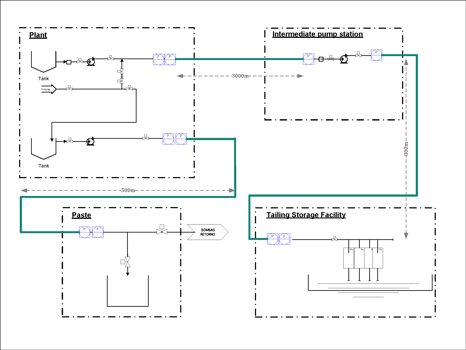
Figure 1: Simplified schematic of a tailings and pulp pipeline system showing plant discharge, intermediate pumping and delivery to the tailings storage facility
This constant evolution complicates instrumentation. Sensors installed today may need to be relocated tomorrow. Harsh slurry conditions shorten instrument life too. Access can be limited, particularly in remote or elevated terrain. Any leak detection system that relies on dense instrumentation along the pipeline must contend with high installation cost, ongoing maintenance burden and operational disruption.
At the same time, the consequences of failure are severe. A leak in a tailings pipeline can release large volumes of contaminated slurry into soil and waterways, potentially triggering landslides, damaging ecosystems and impacting downstream communities.2 Even small leaks can escalate quickly if they go undetected.
Regulation is raising the bar, especially in Latin America
Regulatory frameworks across Latin America are increasingly explicit about the need for early detection and rapid response to tailings leaks.3
In Peru, Supreme Decree 034-2023-EM introduced a clear requirement for automatic shutdown systems in the event of tailings pipeline leakage. While the regulation does not prescribe a specific technology, the implication is clear. Operators must have a means of continuously monitoring the pipeline, detecting hydraulic anomalies and triggering automated responses without operator intervention. This means that a reliable solution should be deployed to protect pipelines while minimizing unnecessary shutdowns.
 Chile approaches the issue from a different angle. The DS 248 regulation governing tailings storage facilities requires operators to implement action plans that include anomaly detection, alerts, notifications to authorities, and emergency response procedures.4
Overlaying national regulations is the Global Industry Standard on Tailings Management (GISTM). The GISTM emphasizes continuous monitoring, early warning and risk based decision making across the full tailings lifecycle.5 For many operators, alignment with the GISTM has become a commercial and reputational necessity, not just a compliance exercise.
Together, these frameworks are pushing operators toward leak detection solutions that work reliably under real operating conditions, not just on paper.
The technology gap in tailings leak detection
Despite growing attention on tailings pipelines, leak detection technology has not always kept pace with operational reality. Many commercially available systems were developed for single phase liquids, relatively stable flow conditions and pipelines that rarely change configurations.
In tailings service, these assumptions break down. Slurry behavior can mask pressure signatures. Density variations complicate model or real-time transient model (RTTM) based approaches. Frequent changes to pipeline geometry introduce uncertainty that is difficult to calibrate out.
One of the most common limitations is leak localization. Many leak detection systems can indicate that a hydraulic imbalance exists but cannot reliably identify where the leak is occurring. In tailings systems where access is difficult and response time is critical, lack of location can limit operational effectiveness during a real event.
Another challenge is cost. High instrumentation density, redundant sensors and complex modeling can make some solutions prohibitively expensive, especially for shorter pipelines that still fall under regulatory requirements. This has led some operators to adopt minimal or low cost approaches that technically meet compliance requirements but offer limited real protection.
In tailings pipelines, where access can be difficult and response time is critical, a non-located alarm can delay isolation and increase the volume of released material. This limitation is particularly challenging for shorter pipelines with multiple outlets, where operators may be forced to inspect large sections of pipelines manually before identifying the source of the issue. As a result, some systems offer theoretical detection but limited practical value during a real event.
The limits of pressure based and SCADA driven approaches
Pressure based leak detection systems are often promoted as a simple and cost effective solution for tailings pipelines. In theory, changes in pressure profiles can indicate leaks or blockages but in practice, tailings slurry presents several challenges.
 High noise level and high solids content can dampen or distort pressure signals. Normal operational events, such as pump starts, valve changes or outlet switching, can generate pressure transients that resemble leaks. Distinguishing between real events and noise becomes increasingly difficult as system complexity increases.
SCADA based algorithms are sometimes layered on top of existing instrumentation to improve detection. While this can add value, these approaches remain highly dependent on data quality and sensor placement. In systems where instrumentation is sparse or frequently reconfigured, algorithm performance can degrade quickly.
There is also the question of trust. Operators need confidence that alarms represent real issues, not false positives. Frequent nuisance alarms can lead to alarm fatigue, delayed response or operators disabling systems altogether. In a tailings context, that risk is unacceptable.
Why flow based leak detection aligns better with tailings realities
Flow based leak detection approaches address many of the challenges inherent in tailings pipelines. By focusing on mass balance and flow behavior rather than local pressure signatures, these systems are better suited to high solids slurry and variable operating conditions.
Flow based leak detection can be implemented using measurement data already available within the operation or through technologies suited to slurry service. This reduces additional field complexity and supports reliable performance in pipelines that are frequently relocated or modified. Architectures that simplify integration and limit dependence on dense instrumentation are better aligned with mining operational realities.
From a detection perspective, flow based systems are well suited to identifying small leaks that may not generate strong pressure signals but still represent significant environmental risk. When combined with proven statistical approaches such as the sequential probability ratio test (SPRT), they can support continuous monitoring and automated shutdown logic in line with regulatory expectations.
Importantly, flow based approaches tend to scale well. Whether a pipeline is a few hundred meters or several kilometers long, the underlying detection principles remain consistent. This makes them attractive for operators facing regulatory requirements that apply to both short and long tailings lines.
Operational realities cannot be ignored
While environmental protection is a primary driver for improved leak detection, operators must also contend with practical constraints. Tailings pipelines are operational assets that do not generate revenue directly. Investments in monitoring and protection are often viewed as cost centers rather than value drivers.
This reality explains why operators frequently ask for solutions that are both low cost and high performance. In many cases, those goals are in conflict. Cheaper systems may meet minimum regulatory thresholds but offer limited detection capability or reliability.
Instrumentation survivability is another concern. Sensors exposed to abrasive slurry and harsh environments require maintenance and replacement. Systems that minimize contact with the process fluid and reduce installation complexity tend to perform better over the long term.
Flexibility matters as well. As tailings storage facilities grow and pipeline routes change, leak detection systems must adapt without requiring extensive reengineering or recalibration. In tailings service, where viscosity and density can vary significantly as pulp composition changes, approaches that rely heavily on fixed hydraulic modelling may struggle to remain stable (see Figure 2). Statistical and data-driven methods that learn from operating conditions can provide more resilient performance, while giving operators deeper insight into pipeline behavior over time.
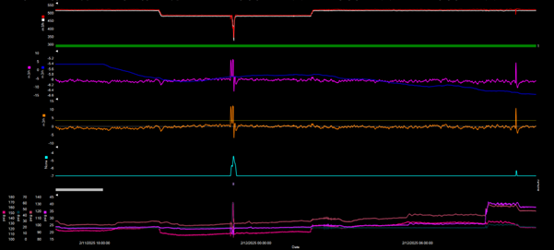
Figure 2: Example operational trend data from a tailings pipeline illustrating flow variability, pressure transients and detection of abnormal hydraulic conditions (from the top: trend 1 - inlet and outlet flow, trend 2 and 3 - raw, average flow difference and corrected flow difference, trend 4 - statistical parameter, trend 5 - pressure)
Regulatory requirements have also had an unintended side effect. In jurisdictions where leak detection or automatic shutdown is mandatory, operators are often required to install systems even on relatively short tailings pipelines. This has created a market for low cost solutions that meet compliance requirements but deliver limited detection performance.
In practice, this means some operators are faced with a difficult compromise, adopting systems that satisfy regulatory audits but provide little confidence in early leak detection or reliable alarm performance. Over time, this gap between compliance and capability can erode trust in leak detection altogether, undermining the very risk reduction that regulation is intended to achieve.
The downstream consequences raise the stakes
The ultimate reason why tailings pipeline leak detection matters is consequence. Unlike many industrial leaks, tailings releases can have immediate and long lasting impacts beyond the mine boundary.6
Downstream communities, agricultural land and water resources are often located in proximity to tailings transport routes. In mountainous regions, a pipeline failure can trigger rapid slurry flows with little warning. The social, environmental and reputational damage can far exceed the direct cost of cleanup.
 Regulators are acutely aware of these risks, which is why requirements increasingly emphasize early detection and automatic response. Operators that rely solely on manual monitoring or delayed alarms are exposed not just to environmental harm, but to legal and financial liability.
Moving from compliance to confidence
As tailings management standards evolve, leak detection should be viewed as part of a broader risk management strategy rather than a standalone compliance item.
Effective systems are those that operators trust, that integrate smoothly with operations, and that provide actionable information when it matters most. This requires realistic assessment of pipeline behavior, fluid characteristics and operational change, not generic solutions borrowed from other industries.
Flow based leak detection is not a silver bullet, but it aligns well with the physical and operational realities of tailings pipelines. When properly implemented with appropriate technologies, it can support regulatory compliance, protect the environment and give operators greater confidence in their ability to manage one of mining’s most critical risks.
In tailings transport, doing the minimum is rarely enough. The cost of getting it wrong is simply too high.
References
1 https://globaltailingsreview.org/
2 https://www.unep.org/resources/report/global-industry-standard-tailings-management
5 https://globaltailingsreview.org/global-industry-standard/